
 +91 6295115701
 fitofine.in@gmail.com
 27A, Town Hall Para, Bardhaman, West Bengal
Why Your Neck Hurts More Than Ever And What Actually Helps
The truth is you didn’t even notice how the pain got so bad. You started your office work just like any normal day, you notice a slight tightness in your neck, so you lean back on your chair. By lunch time the tightness gets a little irritating and by evening you are sitting there slowly rolling your head from side to side, pressing your fingers into the back of your neck, genuinely puzzled about how it got this bad again when you did not do anything particularly strenuous today.
This is not a niche complaint anymore and it is certainly not just an office worker problem. Students, gamers, parents, even kids are facing this same neck issue.Physiotherapy for Neck Pain has become the most honest and effective answer for people who have genuinely tired of these daily inconveniences. Although the painkillers, the heat packs, the long weekend of rest, helped temporarily but again they found themselves right back where they started within a few days. Because those things treat the feeling. They do not come close to healing the actual root cause.

Why Neck Pain from Mobile Use Is Doing More Damage Than You Think
Your head weighs somewhere between ten and twelve pounds. Your neck handles all that weight with ease when you are looking straight ahead. But the moment you tilt your head forward, even a slight degree away from the right portion is increased pressure on the neck area. Some research puts it at four or five times the normal weight when looking at your phone’s notifications putting your head at an angle alone. Your neck muscles are doing an enormous amount of invisible work every single time you scroll, and they are doing it over and over again, hundreds of times a day, every single day.
This is what people mean when they talk about tech neck, and it is one of the most common drivers of neck pain from mobile use that physiotherapists are seeing right now. The muscles at the back of your neck were simply not designed to absorb that kind of load for hours on end. Over weeks and months they fatigue. The natural inward curve of your cervical spine begins to flatten out.
The Laptop Problem Is Different and in Some Ways Even Worse
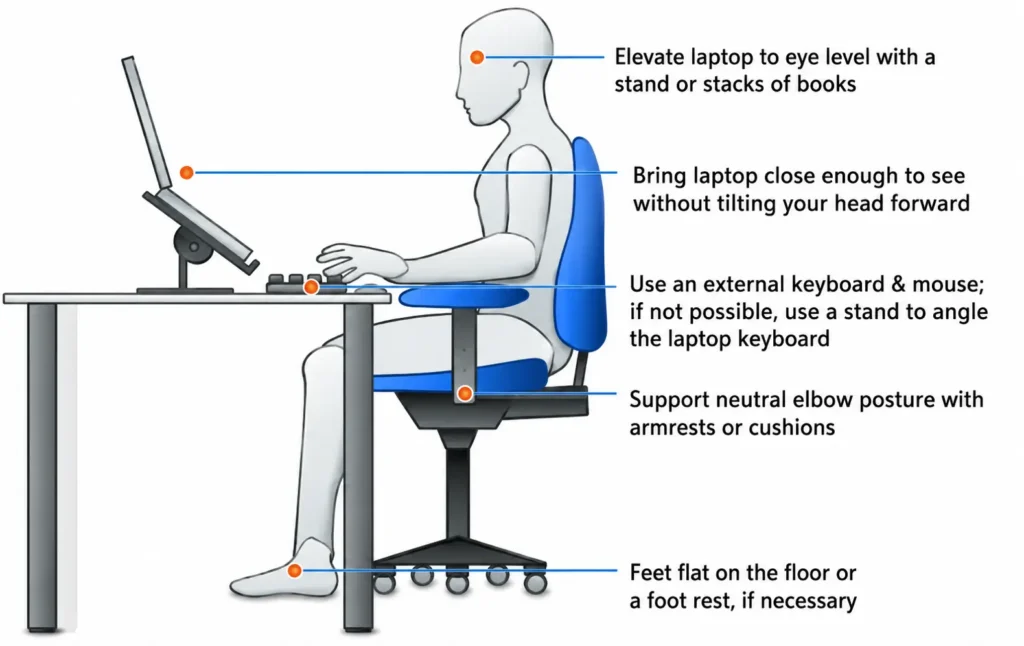
Phones drag your head downward. Laptops pull your whole upper body forward, and that distinction actually matters when it comes to understanding where your pain is coming from and why. Because laptop screens sit low by design, your eyes drop to meet them, your shoulders follow by rolling forward, and your upper back rounds into what a lot of people call laptop hunch. For short periods that is no big deal at all. The real problem with neck pain from laptop use is that people hold this shape for hours at a time, day after day, in environments that were never designed to support sustained concentrated work.
Here is the honest truth about where most of us actually use our laptops. We sometimes use it while sitting on a comfy sofa while the laptop is balanced on a cushion, maybe sometimes on a kitchen table, spending eight hours sitting on an uncomfortable and not at all suitable chair for working that long. Without anything close to proper back support or a screen at a reasonable height. This is the reason why the neck pain starts and gets worse over time.
The Real Reason It Keeps Coming Back Even When You Rest
This is the part that frustrates people the most. You take it easy over the weekend. You sleep in. You avoid your screen as much as you can. It feels a little better. Then you go back to normal life and within a few days the tightness and the ache have returned exactly as before. That cycle is so familiar for so many people that they have quietly accepted it as just being the way things are now.
The core issue is something called static loading. Your neck muscles were not built for staying in a fixed position for long hours without movement. When they hold one fixed position for an extended period, blood flow to the tissue drops. The oxygen delivery slows. The metabolic waste products that naturally accumulate during muscle activity do not get cleared away the way they should. That is the actual reason your neck feels completely fine at nine in the morning and totally stiff up by early afternoon. It is simple, preventable biology playing out in your body every day.
The Symptoms That Are Easy to Dismiss Until Suddenly They Are Not
Neck pain almost never arrives on its own. It tends to bring a whole lot of companions that people neglect for months, sometimes years. Stiffness when turning your head to one side. Tension headaches that arrive almost daily. These all get written off as tiredness, as stress, as getting older, as the result of sleeping in an odd position. Sometimes that is genuinely all it is. But when the same symptoms keep showing up day after day like an unwelcome relative then it is worth paying attention.
If you catch yourself reaching back to rub the back of your neck several times throughout the day, or if waking up with a stiff neck has gradually shifted from being an occasional thing to simply being how mornings feel now, something has been building for a while beneath the surface. The longer it goes unaddressed, the more deeply these patterns tend to the repeats themselves. Chronic cervical pain becomes harder to unwind the longer it has been allowed to settle.
What Physiotherapy Actually Does That Nothing Else Can
There is nothing wrong with taking a painkiller when the pain gets genuinely bad. Managing acute discomfort is reasonable and sometimes necessary. But a painkiller does not know or care why your neck hurts. It just interrupts the signal for a few hours and leaves everything exactly as it was before. When it wears off the tight muscles are still tight, the stiff joints are still stiff, and the movement patterns that created the whole situation are sitting there completely unchanged, ready to build the pain right back up again. Physiotherapy for Neck Pain works from an entirely different starting point. The question is not how do we quiet this down for today but why is this happening and what specifically needs to change for it to actually stop.
A good physiotherapist will spend real time with your posture, carefully test how your cervical spine actually moves, and look at the muscle groups that tend to weaken quietly in people who spend long portions of their day at screens like mobile and laptops.
The Small Daily Things That Either Help or Quietly Make Everything Worse
Professional treatment does the heavy lifting, but what happens in the hours between sessions matters more than most people expect and it is worth being honest about that. Raising your laptop or propping your phone up closer to eye level sounds almost too simple to bother with, but it has a real and meaningful effect on the total load your neck absorbs across a full working day. Getting up and moving around for even two or three minutes every thirty to forty minutes stops the neck pain from laptop use .
Sleep position is one of those things that makes a far bigger difference than its simplicity suggests, and most people are genuinely surprised when they discover how much it matters. Stomach sleeping keeps the neck rotated and holds it there for the entire night, and makes the neck pain worse. A lot of people find that switching to a supportive pillow and learning to sleep on their side or back clears up their morning stiffness within a few weeks, more effectively and more lastingly than almost anything else they have tried.
Final Thoughts
Neck pain from mobile use and the slow daily grind of living with a laptop does not have to be something you manage indefinitely.Understanding what is actually driving it, whether that is the constant downward pull of scrolling through your phone or the forward collapse of hours spent bent over a low screen, is the first genuinely useful step toward sorting it out properly rather than just keeping it at a tolerable level for the rest of your life.
If you are tired of the cycle and ready to actually get to the bottom of it, the team at Fit O Fine is here to help. Fit O Fine builds personalised recovery plans designed around your actual life, your schedule, and the specific habits and patterns that are driving your particular discomfort, not a generic template built for a generic patient.
Whether you are catching early stiffness before it has a chance to become something more serious, or you have been living with chronic cervical pain for so long that you have nearly stopped expecting things to change, Fit O Fine offers the kind of careful, warm, evidence-based physiotherapy for neck pain that gets you moving freely again and genuinely keeps you there.
Frequently Asked Questions
Most people notice a real difference within two to four weeks. It depends on how long things have been building, but staying consistent with treatment and home exercises is what makes the results stick.
Yes. Raise your screen to eye level, take short movement breaks every thirty to forty minutes, and try to stop sleeping on your stomach.
If it has been going on for more than two weeks, comes with headaches, tingling down your arm, or limits how far you can turn your head, get it assessed properly rather than continuing to manage it yourself.
Not if the underlying patterns have genuinely changed. Good physiotherapy builds lasting change, not just temporary relief, and most people find it holds when they keep up with what they have learned.