
 +91 6295115701
 fitofine.in@gmail.com
 27A, Town Hall Para, Bardhaman, West Bengal
Physiotherapy for Back Pain: How It Helps, What Treatment Involves and When You Should See a Physiotherapist
Back pain has a way of sneaking into your routine without you really noticing.
Maybe you wake up a bit stiff and just shrug it off. You get through your workday, sit through a long commute, do some chores around the house and by evening your back is a little tighter than it was. Then, out of nowhere, bending down to tie your shoes turns into something that actually takes effort.
For some people it fades in a day or two. For others, it just won’t go away – or it keeps coming back every few weeks.
That’s usually when physiotherapy starts to matter.
A lot of people assume physiotherapy for back pain is just heat packs, a massage and a printed sheet of stretches. In practice, a proper assessment goes a lot deeper than that. It’s about figuring out why your back is reacting the way it is, which movements are setting it off, how much strength and mobility you’ve actually lost and what you need your body to be able to do again. Everything after that is built around what the assessment finds.
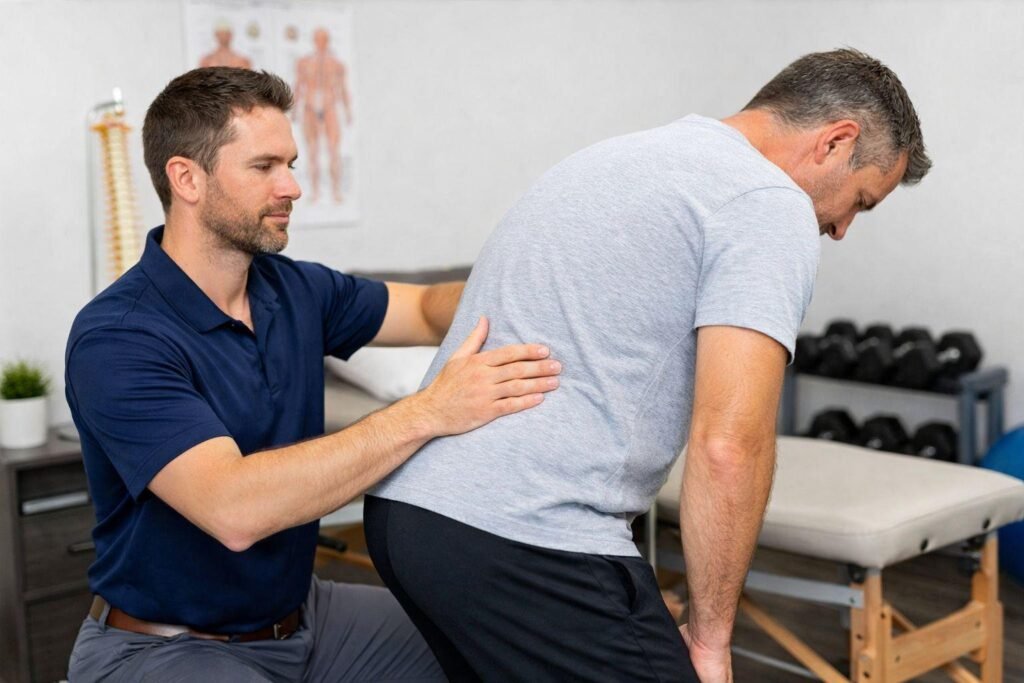
So what actually counts as “back pain”?
Technically, it covers anything from the lower ribs down to the buttocks, though most people who go looking for a physiotherapist are dealing with something in the lower back specifically.
And it doesn’t look the same for everyone. You might be dealing with:
- A dull ache that builds up after sitting or standing too long
- Stiffness the moment you get out of bed
- A pull or twinge when you bend or lift something
- A sudden sharp pain with one particular movement
- Soreness after a long car or train journey
- Pain that seems to spread down into a buttock or leg
- Trouble just walking, exercising, or getting through the day normally
Here’s something worth knowing: most back pain doesn’t have one obvious structural cause you can point to on a scan. The WHO puts the figure for non-specific low back pain at around 90% of cases.
That doesn’t mean the pain isn’t real, or that it’s “all in your head.” It just means you don’t necessarily need a scan to show a torn or damaged structure for the pain to be genuine – or for a physiotherapist to help you recover from it.
Why does my back even hurt in the first place?
Honestly, there’s rarely one single answer.
Back pain can start after lifting something awkwardly, suddenly increasing your activity, or spending long hours sitting in one position. Sometimes, it can even develop without one obvious trigger.
Other things that tend to feed into it:
- Not being very active generally
- Poor or disrupted sleep
- Repeated strain from the same movement or posture
- Weak or under-conditioned muscles
- Tight or restricted mobility somewhere
- A previous back pain episode
- Physically demanding work
- Ongoing stress
- Jumping back into exercise too quickly after time off
Which is exactly why two people can describe almost identical pain and still need completely different treatment plans. A physiotherapist isn’t just hunting for the sore spot – they’re trying to understand the bigger picture of how you move.
When is it actually worth seeing a physiotherapist?
Not every twinge needs an appointment. Plenty of mild episodes settle down on their own with a bit of time and common sense.
That said, it’s usually worth getting assessed if:
- Things aren’t improving
- The pain keeps coming back
- You’ve started avoiding activities because of it
- Sitting, standing, walking, or bending has gotten genuinely difficult
- You’ve stopped exercising because of the pain
- You’re nervous about moving in case you make it worse
- Rest and home remedies haven’t really helped
- It’s starting to interfere with work or day-to-day life
The point of an assessment isn’t only to dull the pain. It’s to work out what’s actually holding you back and how to get you moving properly again – safely.
What actually happens in a physiotherapy assessment?
It usually starts with a conversation, not a treatment table.
Expect questions like: when did this start? Did it come on suddenly or build up gradually? What makes it worse and what eases it? Is it messing with your sleep? Can you still bend, sit, stand and walk without much trouble? Does it travel into your leg or buttock at all? Have you had this before? What are you currently avoiding because of it?
Then comes the physical side of things. Depending on what you’re describing, your physiotherapist might check:
- How your spine and hips move
- Muscle strength
- Motor control
- Everyday functional movements
- Flexibility
- The way you walk
- Neurological signs, if relevant
All of this helps them work out what’s likely contributing to your symptoms and whether physiotherapy alone is enough or whether you need a further medical opinion.

What does treatment actually involve?
There’s no single “correct” physiotherapy program for back pain – it really does depend on your symptoms, what the assessment turns up, your goals and how you respond as you go.
Education first. This one gets underrated. If you’re scared to bend, walk, or exercise because you think movement is going to damage your spine, that fear alone can slow down your recovery more than the injury itself does. Part of a physiotherapist’s job is explaining what’s genuinely safe, what to modify for now and how to ease back into normal life. The WHO actually recommends education and self-care as part of managing chronic low back pain, not just as an afterthought.
Exercise – but the right kind, not a random internet routine. Depending on you specifically, this might include strengthening work, core and trunk exercises, hip strengthening, mobility drills, motor-control exercises, some form of aerobic activity, or functional movements tied to your work or sport. The WHO’s own guidance lists several of these – strengthening, stretching, aerobic work, motor-control exercise and individualized programs – as reasonable options. The real question was never “which single exercise fixes back pain.” It’s “which exercises make sense for this person, at this stage, heading back to these activities.”
Manual therapy, in moderation. Hands-on techniques – joint mobilization, soft-tissue work, that sort of thing – can help with pain or short-term mobility in some cases. But it shouldn’t be the whole plan. NICE guidance is fairly clear that manual therapy should only be used as part of a broader package that includes exercise, sometimes alongside psychological support. The goal is to get you moving independently, not to keep you coming back for a weekly rub that never quite fixes anything long-term.
Easing back into activity. A lot of people swing between two extremes – pushing through everything and ignoring the pain, or resting completely until it disappears. Neither tends to work well. It’s usually smarter to temporarily scale things back and rebuild your tolerance gradually. Someone who can’t sit through a two-hour meeting might start by breaking it up, shifting position often and slowly stretching that out. Someone who quit exercising altogether might ease back in with light movement before returning to their old routine. Recovery is really about rebuilding capacity – not waiting around for a perfectly pain-free day before you try anything.
Can you deal with lower back pain without surgery?
For most people with non-specific low back pain, yes – surgery isn’t the default next step. The WHO’s guideline for chronic primary low back pain leans toward a person-centred plan built around non-surgical options: education, exercise and select physical therapies, often combined rather than used in isolation.
That said, physiotherapy isn’t a substitute for medical care in every case. Some causes genuinely need investigation or specialist input. The point isn’t that surgery is never needed – it’s that it shouldn’t be assumed just because your back hurts. A proper assessment is what tells you which category you’re actually in.
What about pain running down the leg?
Pain that travels from your lower back into your buttock or leg can sometimes point to irritation of a spinal nerve – what people usually call sciatica.
This one’s worth getting properly checked because the symptoms can look pretty different from person to person. A physiotherapist assessing this might look at where exactly the symptoms sit, your strength, sensation, reflexes where relevant, how your spine moves, what you can and can’t do functionally and how things change with different positions or movements.
If anything suggests you need a medical opinion beyond physiotherapy, you’d normally be referred on.
Should you just rest until it goes away?
Generally, no – long stretches of bed rest tend to work against you rather than for you. For most uncomplicated cases, staying reasonably active and easing back into normal activity tends to help more than avoiding movement entirely. The WHO also lists physical activity and self-care among the key pieces of managing low back pain.
That’s not permission to push through sharp pain, though. Think of it more as relative rest – dial back whatever’s clearly aggravating things, but keep moving within what you can tolerate and build from there.
Is it safe to just do back exercises at home?
Some can genuinely help – but copying a generic routine off social media isn’t always a great idea, because the exact same exercise can settle one person’s pain and flare up someone else’s.
A physiotherapist can help you sort out which movements actually suit you, how many reps make sense, how often to do them, how much discomfort is fine to push through and when it’s time to progress or dial something back. The goal isn’t to stack up dozens of exercises – it’s to land on the handful that actually help you and build on those properly.
How long does this usually take?
Honestly? There’s no clean answer here and anyone who gives you one is oversimplifying.
Some people feel noticeably better within a couple of weeks. Others have been dealing with something on and off for months and need a longer, more structured rehab process. It tends to come down to how long you’ve had symptoms, how limited you currently are, your general activity and fitness level, sleep, stress, past episodes, the specific condition involved and – quite a lot, honestly – how consistently you actually stick with the plan between sessions.
A decent physiotherapy program should evolve as you progress, not stay identical week after week regardless of how you’re doing.
Small things that help at home
Keep moving. Don’t spend the whole day in bed or frozen in one position unless a professional has specifically told you to.
Change position often. If sitting sets things off, take regular breaks rather than trying to hold one “perfect” posture for hours straight.
Build strength gradually. Once you’re able to, working on strength and general capacity tends to pay off in the long run.
Don’t ignore sleep. Poor sleep genuinely makes pain harder to manage and can slow recovery down.
Don’t chase zero discomfort. Some rehab movements might feel a bit odd or mildly uncomfortable without actually being harmful. Your physiotherapist can help you tell the difference.
When is back pain actually a red flag?
Most of the time, back pain isn’t a sign of anything serious. But a few symptoms deserve prompt medical attention rather than a wait-and-see approach – get checked urgently if you notice:
- New loss of bladder or bowel control
- Numbness around the genital or saddle area
- Significant or worsening leg weakness
- Severe pain following major trauma
- Fever or feeling generally unwell alongside severe back pain
- Unexplained weight loss or other concerning symptoms
- A history of serious illness where new back pain could be connected
These aren’t things to try to manage with home stretches. If you’re not sure whether your situation fits, it’s always safer to get it looked at.
Why does it keep coming back?
This is probably the most frustrating question people bring to a clinic and the answer is rarely as simple as “your core is weak.”
Back pain can return for several reasons. You may increase your workload or exercise too quickly after feeling better, spend long periods doing repetitive tasks at work, or become less active once the pain settles. Changes in sleep, stress, and your overall activity level can also influence how your body responds to pain and recovery.
A good rehab plan shouldn’t just get you through the current flare-up – it should help you figure out what to actually change once you’re feeling better. That might mean building strength and general fitness, improving your tolerance for work or sport, learning how to handle a flare-up when it happens and generally becoming less nervous about moving.
Physiotherapy for back pain in Bardhaman
If you’re in Bardhaman and back pain is getting in the way of work, walking, exercise, sleep, or just everyday life, it’s worth getting an actual in-person assessment rather than relying on a generic answer pulled from the internet.
At Fit O Fine Physiotherapy Clinic, the approach is built around understanding your specific symptoms, assessing how you move and function and putting together a rehab plan around what you actually need.
The goal isn’t just a back that feels okay for a few days. It’s helping you move with more confidence, rebuild real physical capacity and get back to doing the things that matter to you.
The bottom line
Back pain doesn’t automatically mean something’s seriously wrong with your spine. And treating it isn’t a choice between “do nothing” and “go under the knife.”
For most people, recovery is about understanding what’s actually going on, staying reasonably active, building strength and movement back up, gradually raising your tolerance and following a rehab plan that fits into your actual life – not someone else’s.
The most useful kind of physiotherapy, in the end, isn’t really about the sore spot at all. It’s about answering three simple questions: why is this happening to me, what can I safely do right now and how do I get back to the things I actually want to be doing?
If your back pain isn’t going away, keeps returning, or is getting in the way of normal life, a proper physiotherapy assessment is a reasonable place to start.
Frequently Asked Questions
Q: Should I go to work if my back is hurting?
A: For most uncomplicated back pain, yes – staying off work completely usually doesn’t speed up recovery and it can make going back feel harder the longer you’re away. That said, if your job involves heavy lifting or a lot of awkward postures, you may need to modify certain tasks temporarily, or discuss a graded return with your employer. A physiotherapist can help you figure out what’s genuinely off-limits for now versus what just feels uncomfortable but is fine to do.
Q: Is it a slipped disc?
A: “Slipped disc” is a phrase people use loosely, but discs don’t actually slip out of place – they can bulge or herniate, which is different. Most back pain isn’t caused by a disc problem at all. The only way to know what’s actually going on is through a proper assessment, not by guessing from symptoms alone.
Q: Will it get worse if I keep moving?
A: For the vast majority of people with ordinary back pain, no – movement isn’t dangerous and avoiding it altogether tends to cause more stiffness and fear around movement than it prevents harm. There are exceptions (see the warning signs above), which is exactly why an assessment is useful if you’re unsure.
Q: Should I use heat or ice?
A: Either can offer short-term comfort and which one feels better tends to be personal – some people prefer heat for stiffness, others prefer ice after a flare-up. Neither one fixes the underlying issue, so think of it as a way to make yourself more comfortable while you keep moving, not a treatment on its own.
Q: Why does it hurt more at night or first thing in the morning?
A: This is common and doesn’t necessarily mean anything is getting worse. Staying in one position for hours (like sleeping) can cause stiffness that eases once you start moving. If pain is consistently waking you up or getting steadily worse rather than settling with movement, that’s worth mentioning to a physiotherapist.
Q: What sleeping position is best?
A: There’s no single “correct” position for everyone. Many people with lower back pain find some relief sleeping on their side with a pillow between the knees, or on their back with a pillow under the knees, but comfort varies from person to person. If you’re consistently waking up in more pain, it’s worth discussing with your physiotherapist rather than just switching positions at random.
Q: Can I still go to the gym or play sport?
A: Often yes, sometimes with temporary adjustments. Rather than stopping entirely, it usually makes more sense to modify load, range of movement, or intensity for a while and build back up. A physiotherapist can help you work out which specific movements or exercises to scale back and when it’s safe to progress again.
Q: Is it okay to crack or twist my back myself?
A: Self-cracking might bring brief relief for some people, but it doesn’t address why the stiffness or tension is there in the first place and repeatedly forcing movement isn’t something to rely on as a treatment strategy. If you feel the need to do it often, that’s more a sign your back needs a proper look than something to keep managing yourself.
Q: How much does physiotherapy cost and is it covered by insurance?
A: This varies a lot depending on where you’re being treated and what insurance or health scheme you have. It’s worth asking the clinic directly about session costs and checking with your insurer about coverage before you start, so there are no surprises.
Q: Do I need a doctor’s referral to see a physiotherapist?
A: This depends on where you live and how your local healthcare system works – in some places you can see a physiotherapist directly, while others require a doctor’s referral first, especially if insurance is involved. It’s worth checking with the clinic or your insurer beforehand.
Q: Can stress or anxiety actually make my back pain worse?
A: Yes, this is well recognized. Stress, poor sleep and low mood don’t cause back pain out of nowhere, but they can genuinely amplify how much pain you feel and how hard it is to shake off a flare-up. Addressing those factors alongside physical treatment often makes a real difference and a physiotherapist can help you understand how the two are connected in your case.
Q: Will I need surgery eventually if physiotherapy doesn’t fully fix it?
A: Not necessarily. Most non-specific low back pain is managed without surgery ever coming into the conversation. Surgery becomes relevant for a smaller group of specific conditions where imaging and clinical findings point clearly toward it – and that decision is made with a specialist, not assumed just because physiotherapy hasn’t erased every symptom.
Q: Is it normal to still feel some discomfort during rehab exercises?
A: Often, yes. Some mild or unfamiliar discomfort during rehab movements doesn’t automatically mean damage is happening – bodies that have been guarded or inactive for a while can feel odd as they start moving more. That said, sharp, worsening, or lingering pain is different from normal exercise discomfort and your physiotherapist should help you tell the two apart rather than leaving you to guess.