 +91 6295115701
 fitofine.in@gmail.com
 27A, Town Hall Para, Bardhaman, West Bengal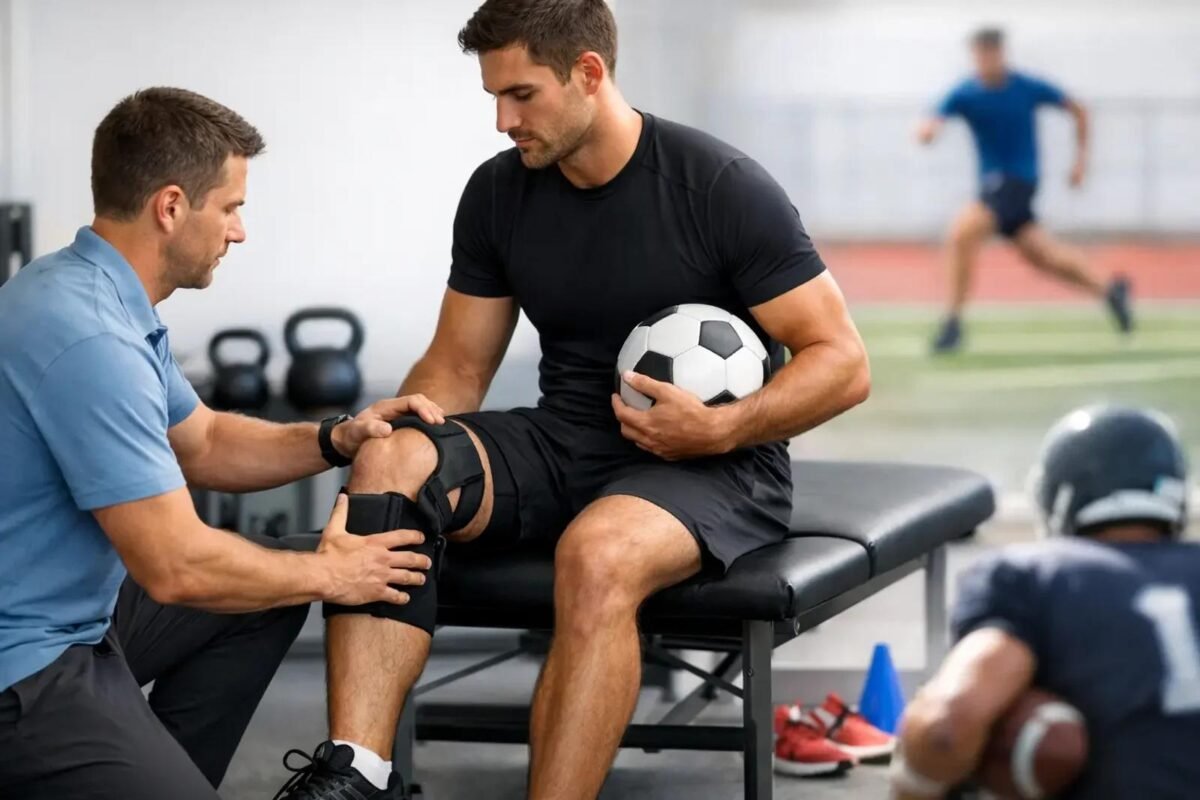
How Does Sports Injury Rehabilitation in Bardhaman Help You Recover Safely?
So what does Sports injury rehabilitation actually means?Let’s be honest it doesn’t make the pain go away in one go. But it’s about working out what went wrong, why it went wrong, and being properly sure your body’s ready before it goes back to the stuff you love doing.
At Fit O Fine, that means hands-on physiotherapy, targeted exercise, and a real plan from your very first appointment to your last. And definitely not handing down some generic program that gets handed to everyone who walks in with the same diagnosis.
Key Takeaways
People most of the time mistake the fading pain equal to being healed and rushing back to your athletic life is one of the surest ways to turn a fresh injury into a long, annoying one.
A good rehabilitation plan is built around you, not copied off a template. And if you start early the chances of hustle free recovery is almost always quicker and more complete, because it gives a very little time to compensate so the little problems don’t become something disastrous in the end. That’s really the whole article in four sentences. Everything below just explains the why.
What Is Sports Injury Rehabilitation?
Ask most people and they’ll tell you rehabilitation just means resting until you feel okay enough to train again. It doesn’t. Not even close.
It’s the process of getting an injured body back to where it can really perform, not just survive through the day.
It’s about movement, strength, muscle control and ultimately building trust in the injured spot when it’s under pressure. All of it has to be rebuilt, in the right order, at the right pace, before going back to sport is actually safe. Skip a step and you’ll usually find out the hard way.
Here’s something we see at our clinic far more than we’d like.
Someone turns up three months after a nasty ankle sprain they figured had healed. They rested a week, the pain settled and they got back to training. Six weeks later, the ankle gave way mid race. Then again, a couple of months after that. By the time they get to us, the ankle’s been shaky for ages, the knee on that side is carrying extra load and what should’ve been a three-week problem has turned into a three-month one. They’re usually a bit embarrassed, too. They shouldn’t be. Nobody explained any of this to them.
Pain going away doesn’t mean they’ve been repaired. Without specific retraining, the joint is basically flying blind, and sooner or later it shows. That’s the gap proper rehabilitation fills. And it’s exactly what we build everything around at Fit O Fine.
Think of it like this. If a car comes back from the garage and the warning light has simply been switched off, you wouldn’t call that fixed, would you? Pain is a warning light. Rehabilitation is the actual repair underneath it.
What Causes Sports Injuries?
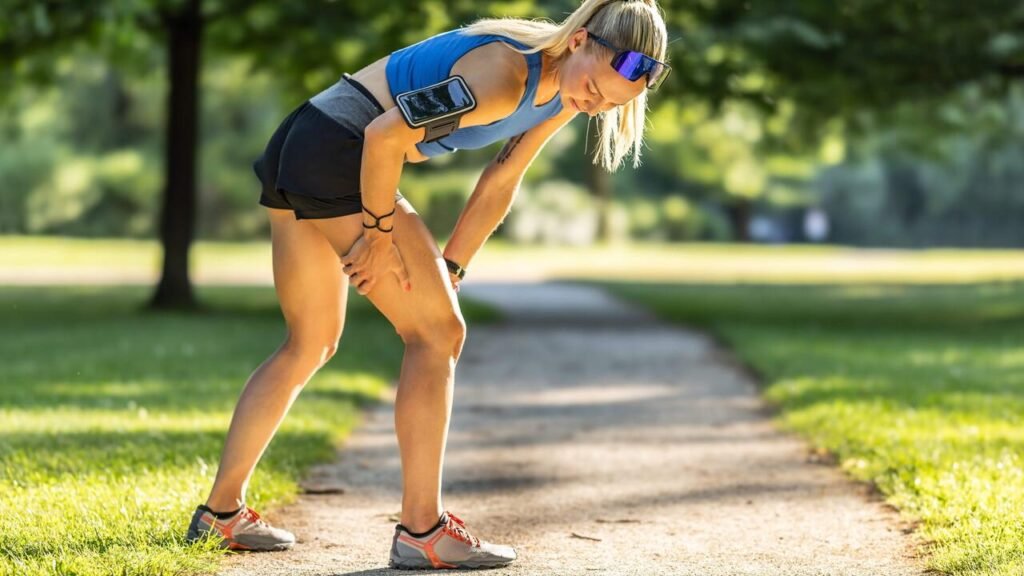
The truth is most sports injuries don’t come out of nowhere, although it feels that way at the moment. You’re playing, running, training, going about your day, everything’s fine and boom…. something went very wrong and you can just feel it in your gut. But there’s nearly always something sitting underneath, quietly building. Usually for weeks. Sometimes for months.
Muscle Strains
A muscle strain happens when the muscle fibres get stretched further than they can cope with, or when they’re asked to produce more force than they’re ready for. Sometimes it’s one sudden moment (a sprint, an awkward landing, a quick change of direction). Other times it creeps up over weeks of putting pressure on a muscle that just isn’t strong or flexible enough for the job.
Hamstrings are probably the most strained muscle in sport. Calf, quadriceps and groin follow close behind.
Grade 1 is minor fibre damage. Grade 2 is a partial tear, with real strength loss. Grade 3 is a complete rupture. Rehabilitation looks very different across the three, and it’s not something to guess at. We’ve had people swear their “pulled muscle” was nothing, only to find out on assessment that it was a proper partial tear. How it feels isn’t a reliable grading system. Really isn’t.
Sprains and Ligament Injuries
In our body ligaments connect one bone to another at a joint. They don’t get the same blood supply as muscles do, which is partly why they heal slowly and why half-finished rehabilitation leaves such a lasting mark.
Ankle ligaments are sprained most often. Knee ligaments, especially the ACL and MCL, matter most when they go. Ligament tear rehabilitation helps in stopping a joint becoming chronically unstable and heading toward early wear and tear, years down the line. And “years down the line” is the part people forget. A knee that was never rebuilt properly at twenty-five can quietly turn into a very unhappy knee at forty.
Overuse Injuries
Honestly, these are the real sneaky ones. No single moment where it started. Just symptoms creeping in, while the person keeps training through them for way too long before admitting something’s wrong.
What most people don’t realise is that rest alone won’t fix an overuse injury. The tissue needs graduated loading to rebuild its capacity. Take the load away, then jump straight back to the same volume that caused the trouble, and you’ve basically restarted the whole cycle. We hear the same line a lot: “But I rested for two weeks!” Yes. And then you ran ten kilometres on day fifteen. The tissue never got a chance to get stronger.
Movement and Training Factors
This is the category nobody checks when they’re in pain, because the injury’s already happened. But honestly? It’s often the most important one.
Poor movement mechanics put structures under loads they were never built for.
A knee that caves inward on landing. A hip that drops with every running stride. A shoulder blade that won’t stay stable during a throw. The person doing it often can’t see any of this, while a physiotherapist spots it straight away. It’s a bit like not hearing your own accent.
Training load mistakes matter just as much. Ramping up volume or intensity too fast is one of the most consistent risk factors we come across. The body does adapt to load, but it needs time.
Push faster than it can adapt and you get injured. Simple.
A cricketer who goes from casual weekend games to a tournament week with daily matches. A runner who adds ten kilometres a week because a race is coming up. Same story, different shoes.
Poor sleep, weak nutrition and high life stress all cut into your ability to adapt too, and a proper assessment looks at every one of them. Yes, even the stress. Your tissues don’t know the difference between a hard training week and a hard work week. They just know they’re tired.
What Are the Most Common Sports Injuries We See?
At a physiotherapy and sports injury clinic the same handful of problems turn up week after week. Although different people, different sports but strangely similar stories.
Sports Sprain
Sports sprain therapy in Bardhaman is something we handle all the time. The ankle sprain is the most common acute sports injury in the world, and one of the most mishandled. The story’s almost always the same. Someone does the right things for the first few days, the pain fades, they head back to sport, and the ankle never gets the balance and coordination work it actually needs. The joint’s sensory system is still impaired. The joint is still vulnerable. It’s just quiet, until it isn’t.
And it’s rarely dramatic the second time. No big fall. Just a small wobble on uneven ground, a slightly awkward step off a kerb, and there it goes again. That’s how “I’ve got weak ankles” turns into a personality trait when it was really just an unfinished recovery.
Ligament Tear
The thing that surprises most people is that not every ligament tear needs a mandatory surgery.
For certain injuries, certain grades, certain individuals, structured rehabilitation without an operation can give excellent results.
In other cases, surgery is the right call and rehabilitation’s job is to prepare the joint beforehand and rebuild it afterwards. Either way, it’s a long, biological process. You can’t rush it faster than the tissue allows.
The harder pill to swallow is that your motivation isn’t the bottleneck. Biology is. Ligament tissue heals at its own pace, and the best thing we can do is make sure every single week of that pace gets used well.
Low Back Pain
Low back pain physiotherapy is one of the areas people ask us about most, because back pain in athletes takes many forms and is rarely as simple as it looks. A muscle strain. Disc involvement. An irritated facet joint.
A stress reaction in the lower spine of a young athlete. Each one needs its own approach, and none of them gets properly fixed by treating the spot that hurts without asking what put the spine in that position to begin with.
Sometimes the back is just the victim. Stiff hips, a weak core, tight hamstrings, and the lower back ends up doing everyone else’s job. You can massage your back all day. If the hips never get sorted, the pain will be back next month, probably with friends.
Neck Muscle Strain
Neck muscle strain treatment comes up most often after contact, collisions or sudden stops. A heavy tackle. A cycling fall. A heading duel. Mild strains settle well with soft tissue work, gentle mobility exercises and posture correction. Bigger ones need a more careful early approach and a slower build-up. And if there’s numbness or tingling down the arms along with the neck pain, get that assessed promptly, before anything else starts. Please don’t wait on that one.
Desk hours matter here too. Plenty of our neck cases are people who play sport in the evening after eight hours hunched over a laptop. The neck was already irritated before the game even began.
Why Proper Rehabilitation Actually Matters
Let’s be honest about the real question here. Does it matter if I just wait it out?
For the mildest cases, maybe not. But for anything beyond mild, proper rehabilitation gives better outcomes, pretty consistently. And here’s the real reason why.
Pain easing early isn’t your body announcing that healing’s done. Pain is usually the first thing to go and the least reliable sign to lean on when deciding about returning to sport.
Tissue healing, strength rebuilding, nerve retraining and the functional prep sport demands all carry on after the pain settles. With plenty of injuries, the tissue is at its most fragile right when it hurts the least, because you feel ready but the biology isn’t. That mismatch is exactly where re-injuries are born.
Stiffness left in place after an injury changes how load travels through the whole chain of movement. An athlete who returns with a stiff ankle will compensate at the knee. A restricted shoulder gets covered by the neck. These compensations stay quiet, until they don’t. The secondary injury that follows often feels totally unrelated to the first one. It isn’t. It’s the same story, just told by a different joint. Strength drops after an injury faster than most people expect. Within days, you can measure it. Within weeks, it’s significant. And here’s the catch (a sneaky one): you usually don’t feel as weak as you are, because the uninjured side picks up the slack. Strength work has to reach the level sport actually demands, not just the level that feels fine for walking around the house.
And then there’s confidence. Nobody likes to talk about it, but it matters. Plenty of athletes return physically ready and mentally hesitant, half-expecting the injury to happen again. That hesitation changes how they move, and sometimes that’s exactly what causes the next injury. Good rehabilitation rebuilds the head as well as the body.
How Long Does Rehabilitation Take?
Honest answer? It depends. And anyone who says otherwise without seeing you isn’t giving you anything useful.
Minor Grade 1 muscle strains, managed well: one to three weeks. Moderate strains and Grade 2 sprains: four to eight weeks, with plenty of variation. Significant ligament injuries managed without surgery: three to six months. Surgical ligament reconstructions, especially the ACL: current evidence backs nine to twelve months before returning to competitive sport, for the best re-injury risk.
Overuse injuries vary the most. Caught early, expect eight to twelve weeks of steady management. Long-standing and poorly handled ones can take six months or more, with ongoing load management after that.
Those numbers can feel long. We get it. Nobody wants to hear “nine months” when they’re itching to play. But a rushed recovery that ends in a second surgery is far longer than a patient one.
So what pushes you toward the faster end? Starting early, sticking with the program, and having someone adjust it based on what your body’s actually showing at each stage, not what a fixed protocol says should be happening. Bodies don’t read protocols. They do their own thing, and a good physio keeps up.
What Can You Do After a Sports Injury?
Current sports medicine has rewritten the trusted old RICE approach (rest, ice, compression, elevation). Nowadays the advice is to go easy on heavy icing and anti-inflammatory tablets in the first 24 to 48 hours. Sounds kinda strange, right?
We’ve all been raised to grab the ice pack the second something hurts. But inflammation is your body starting its own repair job. Shut it down from the very first and too early and you risk making the whole healing process even slower than before.
So the next most logical question to ask is what do you do instead?
Protect the area, but don’t wrap it up and lay down on the sofa. Use compression. Keep it elevated. Move it gently and not forcefully and try to move it within whatever range feels okay. Then build the load back up bit by bit as the tissue heals. Gentle and early beats stiff and late nearly every time.
And here’s the big one. Please don’t read “it doesn’t hurt anymore” as “I’m ready to go on with my training.”
It isn’t.
We’ll keep saying it until you’re sick of hearing it (and then we’ll say it once more). Get assessed early too because the sooner there’s a proper rehabilitation plan, the easier the road tends to be.
When Should You See a Physiotherapist?
Some situations can’t wait. No “let’s see how it feels next week” on these specifically.
If you spot a big swelling around a joint within the first hour and you are not able to put your weight on an ankle or knee afterwards. A pop, a snap, or a tearing feeling right when it happened or numbness, tingling or weakness in your arms or legs after a neck or back injury. Maybe a pain that still hasn’t improved after two or three weeks of looking after it yourself.
Then there’s the one people love to shrug off, which is the same injury, same spot, over and over. Same ankle. Same hamstring. Same bit of the lower back. If it keeps coming back, whatever was done the first time never dealt with why it happened. That’s not bad luck. It needs a proper biomechanical assessment, not yet another round of treatment for this week’s flare-up.
Finding a trusted physiotherapist near me Burdwan early is almost always cheaper, in every sense, than living with a chronic problem that grew because treatment kept getting pushed back. Cheaper in money, cheaper in time, and cheaper in all the matches you didn’t have to miss.
How Does Physiotherapy Help?
Assessment
Everything starts here.
Understanding what’s really going on, instead of guessing.
How the injury happened. How the symptoms have been changing. How you move, how far you can move, how strong you are, how stable everything feels. And the underlying reasons the injury happened in the first place. At an advanced physiotherapy clinic like Fit O Fine, this is where your program gets born. Skip it, and it’s just guesswork dressed up as treatment. And honestly, we’d rather not guess with your body.
Exercise
This is the most vital part of sports injury rehabilitation.
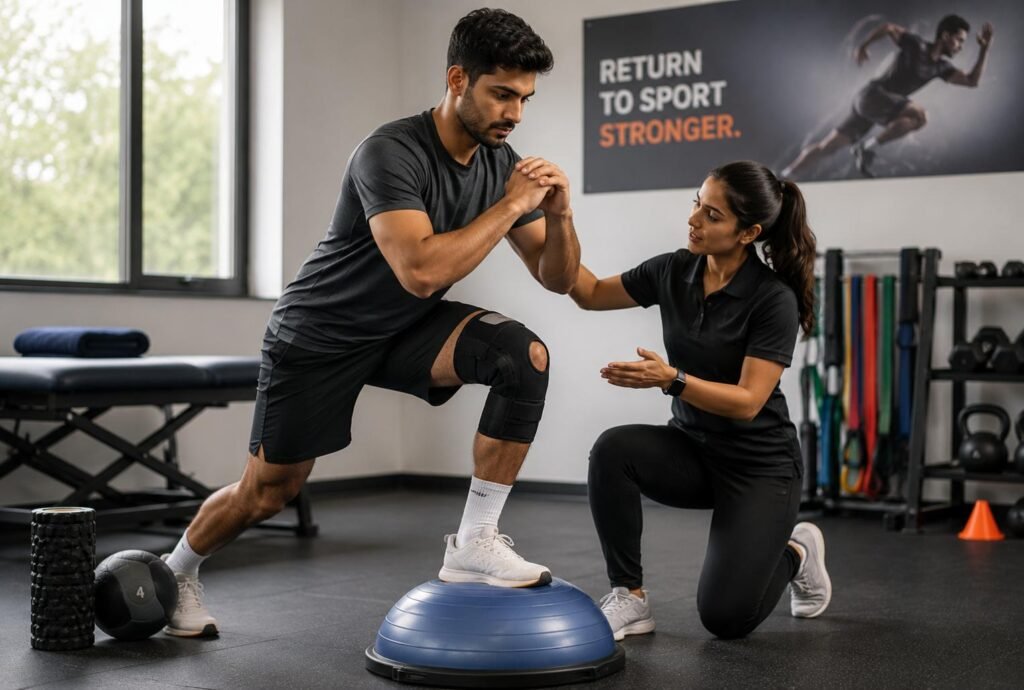
The exercises have to be specific and matched to your injury, your stage of healing and what your sport niche demands from you. Your body heals and adapts in response to the right amount of load and exercise is how we deliver that load without going past what the tissue can handle. Too little and nothing changes. Whereas the wrong kind of exercise can lead you back to square one. Getting that balance right? That’s the real skill.
Manual Therapy
Hands-on treatment eases tight soft tissue,helps in loosening the stiff joints and settles the extra tension that builds up in the structures around an injury. It’s especially useful in the early phase of rehabilitation when pain and sensitivity limit what movement alone can do. Think of it as opening the door so the exercise can walk right through.
Functional Rehabilitation
This is where therapy starts to feel a lot like sport again. Running drills. Changing direction. Landing mechanics. Sport-specific movement, with the challenge creeping up as you get better. It’s also where the nerve retraining really happens, where your nervous system relearns what accurate joint control feels like when sport is demanding it. Most patients tell us it’s their favourite stage. Fair enough. It finally feels like they’re getting their sport back.
What Happens at Fit O Fine, Step by Step?
So here’s the very real version of what happens at your very first appointment. The first appointment is mostly about listening and looking.
It starts with asking about the injury, the symptoms, like the whole context. What sport you play, how often, what a normal week looks like for you.
Then comes a physical exam covering your posture, movement, range of motion, structural testing, and neurological screening where it’s needed.
From there the limitations turn into goals.
Restricted mobility. A particular weak muscle. A movement pattern that helped cause the injury. Your rehabilitation program gets built around those findings, not just around the diagnosis.
Two people with the exact same sprain can walk out with totally different plans. That’s not a mistake. That’s how it should work.
Every exercise gets taught properly before it goes home with you. We’d honestly rather spend ten minutes getting one movement right than send you off with six done badly. As your capacity grows, the prescription changes. Progress gets checked at every appointment against where you started, and the program adjusts as it goes. If the outcome doesn’t match the expectation, then we change the approach. If something’s moving faster than expected, we move it forward.
After that comes follow-up through the early return period, with advice on load management and prevention. Not a handshake and goodbye. A proper handover back to your sport.
What to Look for in a Sports Physiotherapy Clinic in Bardhaman
If you’re hunting for a physiotherapy clinic Bardhaman with real sports injury experience, a few things genuinely separate good care from average care. Here’s what we’d look for if we were in your shoes.
- Look for a clinic with experience in sports injuries specifically. It’s a different area of practice from general physiotherapy and the difference shows in how the assessment is done, how rehabilitation gets built, and how return to sport is handled.
- A proper assessment before any treatment. A plan cooked up in the first ten minutes of a first appointment isn’t based on a real assessment. Sports injury assessment takes time. If someone’s reaching for a machine before they’ve asked you a single proper question, that’s worth noticing.
- A program built around you and your specific condition. Are your exercises specific to your injury, your sport and your stage of healing? Or do they look like a manual template given to everyone with the same diagnosis? You can usually tell pretty quickly. Your gut’s usually right on this one.
- Honest communication. A good clinic tells you what’s going on, why each part of the program is there, and what to expect. You shouldn’t be left guessing what you’re working towards, or why you’re doing the same exercise for the third week running.
Prof. Satyen Bhattacharyya at Fit O Fine brings 18 years of clinical experience to every assessment and every program. Cricketers, footballers, runners, gym regulars, weekend warriors. What they all share is that they came wanting to recover properly, not just quickly. And honestly, those two usually turn out to be the same thing.
How to Find the Right Sports Physiotherapist in Bardhaman
Before you book anything, ask. Ask how it works. What will they look at, why, and how does it shape the program?
If a physiotherapist can explain that in plain words without hiding behind jargon, that’s a really good sign. One short phone call can tell you a lot, honestly.
Be a little suspicious of timelines that sound too good.
For example an ACL reconstruction doesn’t wrap up in six sessions or a Grade 2 hamstring strain isn’t back to full sprint speed in two weeks (we wish it were, we really do). Promises like that don’t match how tissue heals, and a good physiotherapist won’t make them, even when it would make the sale a whole lot easier.
Then there’s the partnership bit. Good physiotherapy is a team effort, and you’re on the team. The physiotherapist brings clinical expertise. You bring everything you know about your body, your sport, and what you actually care about getting back to. Both matter. If you walk out of an appointment having understood next to nothing, don’t brush that off. Trust that feeling.