
 +91 6295115701
 fitofine.in@gmail.com
 27A, Town Hall Para, Bardhaman, West Bengal

How Does Frozen Shoulder Physiotherapy in Bardhaman Help Relieve Pain and Restore Movement?
The short version:
Frozen shoulder physiotherapy aims to ease the pain first, then gives your shoulder its movement back bit by bit, with gentle stretching and exercises matched to your stage. It’s not a quick fix.
But with the right plan at the right time, most people get back to their normal routine with far more motion (and far better sleep) than they would by simply waiting it out.
Key Takeaways
- A frozen shoulder pain moves through stages and what helps in one stage can actually hurt in another stage.
- Pushing through sharp pain almost always backfires. Gentle, regular and patient steps always beat the heroic ones.
- Left alone, it often takes one to three years to settle. Physiotherapy can make those months more comfortable, and for many people shorter.
- Shoulder stabilization therapy comes later, once the stiffness eases, so your shoulder doesn’t just move again… it moves well.
- Sleep, small daily habits and a decent home routine matter as much as the clinic sessions.
- If you can’t reach behind your back or lift your arm to comb your hair, get it looked at sooner rather than later.
Let me guess how you ended up here.
It’s late. Or very early, depending on how you look at it.
You rolled onto the sore side in your sleep, the shoulder ache is bad enough and now you’re wide awake, thumb hovering over the screen, typing something like “why won’t my arm lift and why there is a lingering pain in my shoulder area”
I know that moment because I’ve sat across from it for twenty-odd years. The opening line barely changes. “I can’t put my shirt on properly.” Or, quieter, almost embarrassed: “I haven’t slept through the night in weeks.” And somewhere underneath, the real worry.
Is this permanent?
Did I do something wrong?
Will I ever get my arm back?
Early in my career I’d have answered with a lecture on capsules and ranges of motion. These days I start with a cup of tea and a much simpler message: you’re not broken, and you’re not the only one going through this.
So here’s the honest advice: A frozen shoulder is miserable. It’s also one of the more predictable shoulder problems out there and it responds well to the right help at the right time.
In this guide we’ll talk about what’s happening inside the joint, how the stages work, what you can do at home tonight, and how frozen shoulder physiotherapy in Bardhaman can help you ease the pain and get your movement back. Grab a coffee or a chai. It’s a long one, because the useful stuff lives in the details.
What Is a Frozen Shoulder?
So let’s imagine it this way, picture your shoulder joint wrapped in a thin, stretchy sleeve. Doctors call it the joint capsule. On a good day it’s loose and roomy, and your arm swings around in every direction without you giving it a second thought.
In a frozen shoulder, that sleeve gets inflamed, then thick, then tight. Think of a leather glove left out in the cold overnight. Stiff. Shrunken. Refusing to open the way it used to. Everything inside the joint has less room, so the moment you try to lift or rotate the arm, it hits a wall.
The medical name is adhesive capsulitis, which sounds far scarier than it is.
All it really says is that the capsule around the joint is inflamed and sticky, and your movement shrinks as a result.
Now, here’s a clue that separates it from a lot of other shoulder problems and it’s worth tucking away. With many shoulder injuries, say a rotator cuff strain, you can’t lift your arm yourself, but if someone else raises it for you, it goes up just fine. With a true frozen shoulder, it doesn’t matter who’s doing the lifting. The joint itself is stuck. You and I would both hit the same wall, usually in the exact same spot. (Patients are often oddly relieved when they see this. “So it’s not just me being dramatic.” No. Never.)
One more thing, because it matters. A frozen shoulder isn’t a sign that you’re weak, or “getting old,” or that you did something careless at the gym. It’s a real condition with real, understandable biology behind it, and it’s far more common than most people realise.

What Causes Frozen Shoulder?
Sometimes… nobody knows. That’s the annoying part.
A lot of people wake up one week with a sore shoulder and no injury, no fall, no dramatic moment to point at. I’ve watched people replay the last month in their heads, hunting for the culprit.
Was it the heavy bag?
The ceiling fan they cleaned? Usually there’s no large enough reason to doubt about.
But there are patterns.
It’s most common between roughly 40 and 60 years old, and women get it a bit more often than men. If you have diabetes, your risk is higher, and the frozen shoulder can be more stubborn and longer lasting. Thyroid problems are linked too. A few other conditions, including some heart and neurological ones, show up more often in people with frozen shoulders, though nobody fully understands why.
Say you break your wrist, or have surgery on your chest or arm, or the shoulder is sore after a fall. Your arm sits in a sling for a few weeks, you protect it (which is exactly what you’re supposed to do), and while you’re busy healing the original problem, the shoulder quietly stiffens up behind your back.
There’s a cruel irony in that. Rest is the right call for the first injury. But a shoulder left unmoved for too long can start to tighten. It’s one reason a physiotherapist will often get you moving gently, as soon as your doctor says it’s safe, even after an injury or operation somewhere else in the arm.
Stress and poor sleep haven’t been shown to cause it, but they sure make the pain feel louder. A tired, worn-out nervous system turns up the volume on everything.
What Are the Common Symptoms of Frozen Shoulder?
The pain tends to arrive first, and it’s rarely subtle.
Usually it’s a deep, dull ache in the shoulder, sometimes spreading down the upper arm. It’s often worse at night, and worse when you lie on that side. Plenty of people tell me it feels like the pain is “inside the bone,” which is a pretty good description of how deep it sits.
Then the stiffness creeps in alongside it. Not all at once, of course. That would almost be easier, because you’d know straight away that something was off.
Instead, it sneaks up through everyday tasks.
- Reaching behind your back to tuck in a shirt or fasten a blouse.
- Lifting your arm to comb your hair or reach a high shelf.
- Pulling a seatbelt across your body, or reaching into the back seat.
- Rolling over in bed without waking yourself up.
That’s how most people notice.
Not from the pain itself, but because the little automatic things turn into small, irritating negotiations. You start twisting your whole body to reach a cupboard. You use your other hand to lift the sore arm into a sleeve. You quietly stop reaching for things altogether, and honestly, you barely notice you’ve stopped.
A few other signs are worth knowing. The pain may flare if someone bumps it or you move too quickly. And it often feels weak, though that’s usually because pain stops you from using it properly, not because the muscles have vanished overnight.
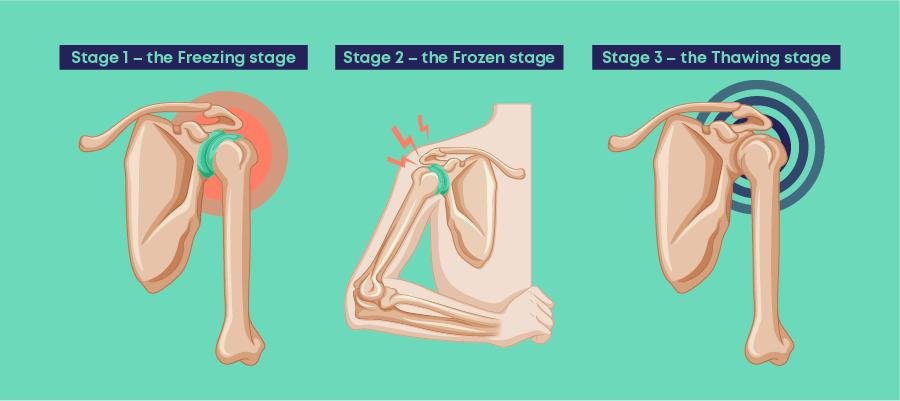
What Are the Stages of Frozen Shoulder?
This is the part I wish every patient knew on day one, because the stage decides the treatment. Do the right thing at the wrong time and you can make the shoulder angrier. Do the right thing at the right time and things start to shift.
Most people describe three stages. They blur into each other, and the timelines vary a lot from person to person, so think of them as a rough map, not a stopwatch.
- The freezing stage (roughly 2 to 9 months). Pain is the star of the show here. The shoulder is irritable, sore even at rest, and getting stiffer by the week. The capsule is inflamed and angry, a bit like a toddler who’s skipped a nap. You don’t wrestle a toddler like that. We don’t try to force anything either. The goal is calming things down, keeping movement within what the shoulder will tolerate, and helping you sleep. If someone is cranking your arm into stretches at this stage, that’s usually a sign the plan needs rethinking.
- The frozen stage (roughly 4 to 12 months). The pain often eases a little, which feels like good news, and then you realise the stiffness has settled in properly. The glove is fully stiff now. Movement is limited in most directions and daily tasks need workarounds. This is where graded stretching and hands-on joint mobilisation start earning their keep, because the shoulder can finally tolerate a bit more.
- The thawing stage (roughly 5 to 24 months). Slowly, almost invisibly, movement starts coming back. Please don’t expect fireworks. Expect the quiet kind of progress, the sort you notice when you suddenly reach for the top shelf one morning and realise you didn’t plan it. Strength and control work really matter here, because the shoulder has been underused for so long.
A word on patience, since it’s the hardest part.
Most people want to know exactly which stage they’re in so they can count down the days. I get it, I’d want that too. But the stages don’t run on a calendar, and a shoulder that’s been in the freezing stage for two months might behave very differently from your neighbour’s. What matters is that your treatment matches what your shoulder is doing now, not what a chart says it should be doing.
Why Is Frozen Shoulder Physiotherapy Important?
Because “wait and see” is a plan, but it’s not a very kind one.
Fair enough, a frozen shoulder often does improve on its own. That’s the reassuring bit.
But it can take a long time, sometimes a couple of years, and in the meantime a lot of knock-on trouble builds up around it. The muscles around the joint get weaker. Your neck and your other shoulder start working overtime to cover for the sore one. Your posture shifts. Your sleep takes a beating, and when you’re not sleeping, everything hurts more. It’s a loop, and it’s a hard one to climb out of alone.
Good frozen shoulder physiotherapy breaks that loop in a few ways at once.
It eases the pain so you can move more comfortably, which in turn helps the joint loosen.
It protects the movement you still have, so the shoulder doesn’t tighten any further. And maybe the most underrated part, it teaches you what to do and what not to do at home, so you’re not left guessing between sessions.
Clinical practice guidelines for adhesive capsulitis support using exercise and manual therapy as part of care, and many people also do well combining physiotherapy with medical options such as pain medication or injections when their doctor recommends them.
Physiotherapy doesn’t have to be the only tool. It’s often the one that stays with you the longest, though, because it’s the one that gets you moving again and keeps you moving.
How Long Does the Frozen Shoulder Take to Recover?
I really wish I could hand you a neat number.
I can’t and anyone who promises you an exact date is just purely guessing.
Here’s the broad picture.
Without treatment, most frozen shoulders run their course over about one to three years. Some are quicker. Some, especially in people with diabetes, can be slower or leave a bit of lingering stiffness. Frozen shoulder physiotherapy often makes the journey more comfortable and, for many people, shorter. It won’t flip a switch, but it can make the climb less steep.
What I tell people is this. You’ll probably feel the pain ease before the movement fully returns. That’s normal, and it can feel strange, because you expect to feel “better” in one clean sweep. Instead, it’s staggered. First you sleep a little better. Then getting dressed stops being a production. Then, one day, you realise you reached the seatbelt without wincing, and you didn’t even think about it.
So don’t judge progress only by how far your arm lifts. Those first wins count, and they count a lot. A shoulder that lets you sleep for six hours is already a different shoulder from the one that woke you every night.
A few things tend to affect how long it takes:
- Which stage you’re in when you start. Starting early gives you more room to work with.
- Other health conditions. Diabetes, for example, can slow things down.
- How consistently you do your exercises. A little every day beats a lot once a week.
- How irritable the shoulder is. A calmer shoulder usually tolerates more progress.
None of that is meant to scare you. It’s just that “how long?” really depends on you, your shoulder and your life, which is why a cookie-cutter plan rarely works.
What Can You Do at Home to Manage Frozen Shoulders?
Between clinic visits, you’re the one in charge, and honestly, what you do at home often matters more than what happens in the clinic. Here’s what I’d tell a friend sitting right across from me.
Warm it up first. A warm shower, or a heat pack on the shoulder for 10 to 15 minutes, loosens the tissues and makes stretching far more pleasant. Make sure the heat is comfortable, never scorching, and keep a cloth between the pack and your skin.
Try gentle pendulum swings. Lean forward a little, support yourself with your good hand on a table, and let the sore arm hang down like a rope. Then let it sway gently, forwards and backwards, side to side, in small lazy circles. You’re not forcing anything. You’re letting gravity do the work. A minute or two is plenty to start.
Use the table slide. Sit beside a table with your sore arm resting on it, a towel under your hand. Slowly slide the hand forward, leaning your body gently over it, until you feel a mild stretch. Hold for a few breaths. Come back. It’s easy to do.
Stretch to a firm tug, not a stab. This is the golden rule. A good stretch feels like a firm pull. A bad one feels sharp, hot or like something is grabbing at you. If you’re gritting your teeth, you’ve gone too far, and the shoulder will let you know tomorrow, loudly. More pain doesn’t mean more progress. Usually it means a cranky shoulder and a step backwards.
Sort out your nights. Sleep is where a lot of people suffer most. Try lying on your other side with a pillow hugged in front of you, so the sore arm has something to rest on. If you sleep on your back, tuck a small pillow or folded towel under the sore elbow so it isn’t dragged backwards. It’s not glamorous, but even one better night can lift your whole week.
Keep using it, within reason. Resting the arm completely feels logical, but it tends to make things stiffer. Use it for light daily jobs, like brushing your teeth, eating and typing, as long as it doesn’t spike the pain.
Little and often wins. Five minutes, a few times a day, beats one heroic half hour on Sunday. Honestly. Set a phone reminder if you need to, I do that for my own stretches and I’m supposed to be the expert.
And one last thing, because people ask. Please don’t let anyone, a relative, a neighbour or a well-meaning friend, yank your arm “to loosen it up.” I’ve seen that go badly more than once. A frozen shoulder needs persuading, not wrestling.
When Should You See a Physiotherapist?
Sooner than you probably think.
A lot of people wait months, hoping it’ll just pass, and by the time they come in, the shoulder is deep in the frozen stage and they’re exhausted from poor sleep. (If that’s you, no judgement. Most of us wait, hoping tomorrow will be a better day.)
Consider booking an assessment if:
- Your shoulder pain has hung around for more than a couple of weeks.
- Night pain is wrecking your sleep.
- Everyday moves, like reaching behind your back or lifting your arm overhead, are getting harder.
- You’ve had a recent injury, surgery or time in a sling, and the shoulder feels stiff.
Early help often means less stiffness to undo later, and a much clearer idea of what you’re dealing with. It also helps rule out other problems that look similar like rotator cuff trouble, arthritis in the shoulder and neck issues can all mimic the symptoms of a frozen shoulder, and they need a different approach.
How Can Physiotherapy Help Restore Shoulder Movement?
Think of it as a conversation with your shoulder, not an argument. If you shout at it, it digs in. If you listen, and nudge, and nudge again, it starts to give.
Here’s how that plays out, stage by stage.
In the painful, freezing stage, the main job is calming things down.
That might mean gentle, pain-free movement, positioning advice for sleep and daily life, and hands-on techniques or other pain relief physiotherapy methods that settle the irritation. We’re not chasing range here. We’re protecting you, easing the ache and keeping the shoulder from locking up any faster than it has to.
In the thawing stage, the focus shifts. Movement is coming back, but now the muscles are weak, out of practice and a bit unsure of themselves. This is when strength, control and coordination work really matter, because a shoulder that moves but doesn’t trust itself tends to get sore again.
And that’s where pain relief physiotherapy in Bardhaman, or anywhere, stops being just “treating the ache” and turns into rebuilding the whole shoulder, so the relief actually lasts.
The neck and shoulder blade matter too. A stiff shoulder often drags the neck and upper back into the mess. Loosening those areas gives the shoulder more room to work.
Small wins build trust. A degree or two of extra movement doesn’t sound like much. But when you’ve been stuck for months, it feels enormous, and it gives you the confidence to keep going. I’ve seen grown adults tear up because they finally scratched their own back. It’s a big deal. Never let anyone tell you otherwise.
One thing I’ve noticed over the years is that the people who do best aren’t always the toughest. They’re the most consistent. They show up, they do the small exercises, they’re patient with themselves. That’s really the secret sauce.
What Is Shoulder Stabilization Therapy?
Here’s something that surprises people. Your shoulder is the most mobile joint in your whole body, which sounds wonderful… until you realise it also makes it the least naturally stable. Picture a golf ball sitting on a tree. It can roll in nearly any direction, but it needs a lot of help to stay put.
That help comes from muscles.
Mainly the rotator cuff, a group of four small muscles that hug the joint, and the muscles around your shoulder blade, which act like a steady platform for the whole arm to move from.
Shoulder stabilization therapy is about training those muscles to hold the joint in the right position while you move. It teaches the shoulder to be steady, not just flexible.
Now, here’s the important bit for frozen shoulders. Stabilization work usually comes in later. If you start strengthening too early, you’re asking a tight, stiff joint to do hard work, and it will protest (loudly, as we’ve established).
Once the pain has settled and movement is returning, the timing flips. Your shoulder has the range, but it’s been underused for months, and the muscles supporting it have grown weak and sluggish. That’s the window where shoulder stabilization therapy shines.
In practice, it often looks like simple, controlled exercises rather than anything flashy. Slow movements with light resistance bands. Exercises that wake up the muscles around the shoulder blade. Gentle weight-bearing work, like leaning on a wall and making small controlled shifts. Practising everyday movements, such as lifting a cup to a high shelf, so the strength carries over into real life.
The payoff is a quiet kind of confidence. You reach into a cupboard or lift a bag, and there’s no nervous little hesitation first. The shoulder just does it.
It’s worth mentioning that shoulder stabilization therapy isn’t only for frozen shoulders. People with shoulder instability, repeated dislocations or sports-related shoulder pain use it too. The principle’s the same: a steady shoulder is a comfortable shoulder. For someone coming out of a frozen shoulder, it helps the joint cope with everyday loads again after months of disuse.
What Happens During Frozen Shoulder Assessment and Treatment?
If you’ve never seen a physiotherapist before, it helps to know what to expect, because the unknown is half the stress.
The first visit is mostly listening. When did it start? Was there an injury? What does night-time feel like? What’s the one thing you really want to do again but can’t? That last question matters more than people think, because it gives us a goal that’s actually yours, whether it’s hanging laundry, reaching the top shelf or lifting a grandchild.
Then we look at how you move. We watch how your neck, shoulder blade and arm work, first on their own and then with a bit of help. We measure the range in different directions and see where it stops, and whether it’s pain or stiffness doing the stopping. We test strength, check your posture, and ask about your general health, including conditions like diabetes, because they shape the plan.
From there, we build a plan around your stage, not a copy-paste sheet. Expect some hands-on work to ease pain and loosen the joint, a handful of exercises for home, and practical advice for sleep and daily life. The home exercises are kept short on purpose. Nobody sticks to a twenty-minute routine in real life, and an easy five minutes done daily beats a perfect plan left in a drawer.
Then we adjust.
Your shoulder will change over weeks, so your plan should too. What suits the freezing stage won’t suit the thawing stage. Good treatment means regular check-ins, re-measuring, tweaking, and being honest when something isn’t working.
And if your symptoms don’t seem to fit a frozen shoulder, or something that looks like it needs a doctor’s input, a good physiotherapist will tell you straight, rather than keep you in treatment that isn’t right for you. That honesty is part of the job.
How to Find Pain Relief Physiotherapy in Bardhaman
Searching for pain relief physiotherapy in Bardhaman can feel overwhelming, because a lot of clinics look alike from the outside. A few things are worth looking for.
They actually assess you. If you get handed the same machine and the same ten exercises as everyone else in the waiting room, think twice. A frozen shoulder needs a plan matched to your stage.
They explain things. You should leave knowing what’s wrong, what the plan is and what to do at home. A good physio is happy to answer questions, even the “silly” ones. (There aren’t any, by the way.)
They set realistic expectations. Anyone promising a cure in three sessions is selling something. Honest timelines, even slightly boring ones, are a good sign.
They know when to refer you. If something needs a doctor, an X-ray or another opinion, they’ll say so.
They make it doable. Treatment you can’t fit into real life won’t work. Look for someone who thinks about your job, your family and your routine.
That’s the approach we take at Fit O Fine. If you’re looking for frozen shoulder physiotherapy that’s built around you, with careful pain relief and proper shoulder stabilization therapy once your shoulder’s ready for it, we’d genuinely love to help.
Frequently Asked Question
Q1. Is frozen shoulder physiotherapy painful?
It shouldn’t be sharp or unbearable. Some stretching discomfort is normal, but we work within what your shoulder can handle.
Q2. Can frozen shoulders heal naturally without treatment?
Often yes, but it can take a long time and leave lingering stiffness. Physiotherapy helps you recover more comfortably.
Q3. How many physiotherapy sessions will I need?
It depends on your stage and how irritable the shoulder is. You’ll get a clearer idea after the first assessment.
Q4. When does shoulder stabilization therapy start?
Usually once pain has settled and movement is returning, so you’re strengthening a shoulder that can actually move.
Ready to Get Your Shoulder Moving Again?
You don’t have to keep sleeping badly or working around a shoulder that won’t cooperate. At Fit O Fine, we offer frozen shoulder physiotherapy with a plan that fits your stage and your lifestyle.
Book your assessment at Fit O Fine today and take the first step towards moving freely again.