
 +91 6295115701
 fitofine.in@gmail.com
 27A, Town Hall Para, Bardhaman, West Bengal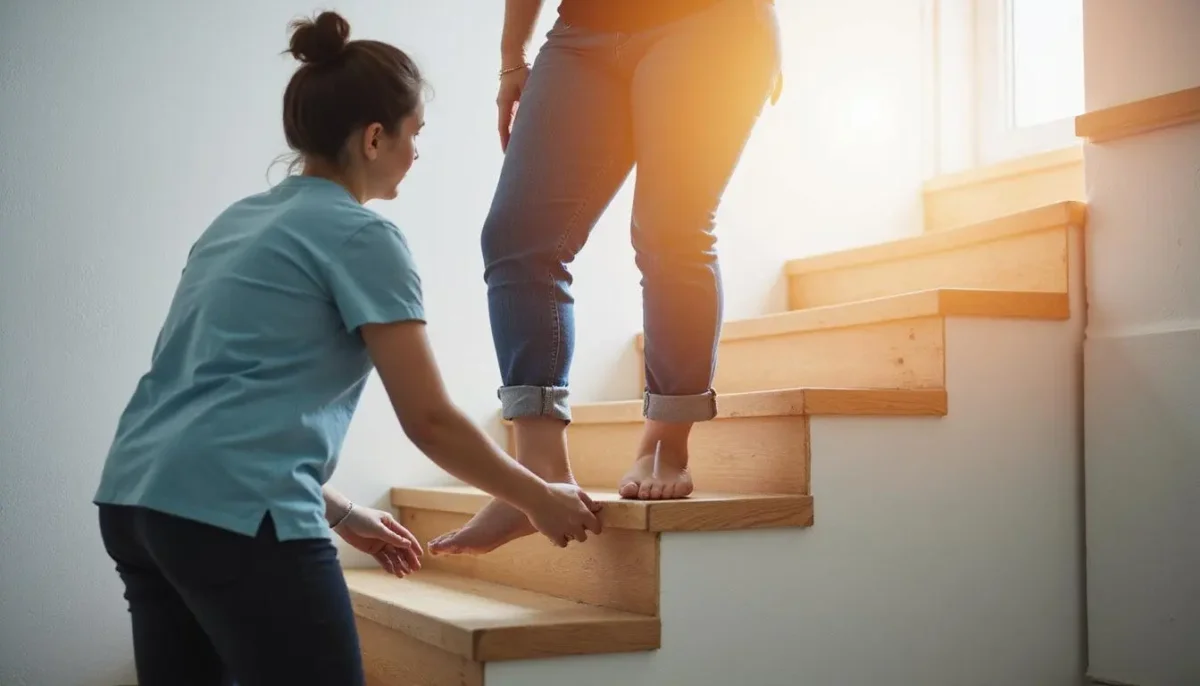
Knee Pain Physiotherapy: Causes, Exercises, Treatment & When to See a Physiotherapist
A patient told us recently that her knee behaves perfectly until the second step of any staircase. That’s oddly specific, but honestly, most knee pain does show up exactly like that – fine, fine, fine and then one particular movement flips a switch.
For someone else, it’s standing up from a low sofa. For another, it’s a bit of puffiness around the joint after a walk that used to be nothing. Sometimes there’s a click that wasn’t there a year ago. Sometimes it’s just a flat, low ache that’s refused to leave for the better part of a month.
Knees have a way of inserting themselves into things you’d never think to notice otherwise – walking to the kitchen, bending down to pick something off the floor, getting out of a car, sitting with your legs folded under you. Stairs, in particular, seem to be where a lot of people first notice something’s wrong.
There’s almost never one tidy explanation for it either.
At Fit O Fine, the knees we see come from injuries, arthritis, sport, recovery after surgery and everyday movement problems that have crept up slowly. Our orthopedic physiotherapy approach starts with understanding what’s actually bothering the knee rather than simply trying to numb the pain.
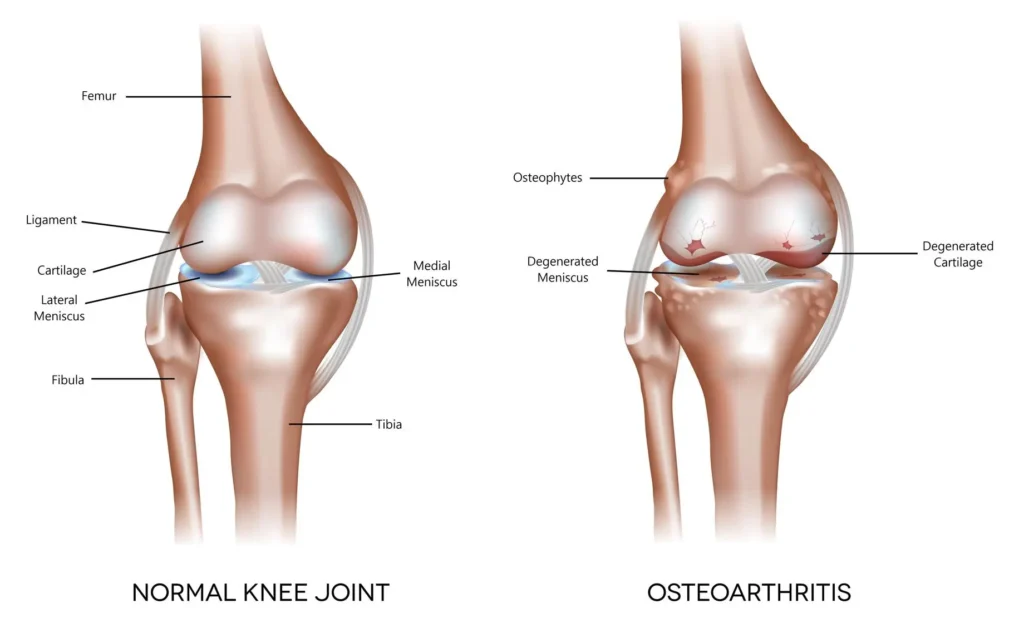
So What’s Actually Causing It?
There’s a fair spread of possible culprits here.
Sometimes it’s a specific injury – a bad twist, a fall, an awkward change of direction – that strains or damages something in or around the joint. That covers sprains, ligament injuries, tendon problems, or a torn meniscus or cartilage.
Other times, there’s genuinely no single moment to blame.
Osteoarthritis tends to show up this way – gradually, usually with stiffness riding alongside the pain rather than appearing out of nowhere. Repeated strain, a sudden increase in activity, weaker muscles around the joint and other joint problems can all play a part as well.
Then there’s the sporting side – runner’s knee, ligament sprains and strains, that sort of thing. That’s a fair chunk of what falls under our sports injury physiotherapy work at the clinic.
Point being: if your knee’s sore, resist the urge to immediately decide it’s arthritis. It could be. It might just as easily be something completely unrelated.
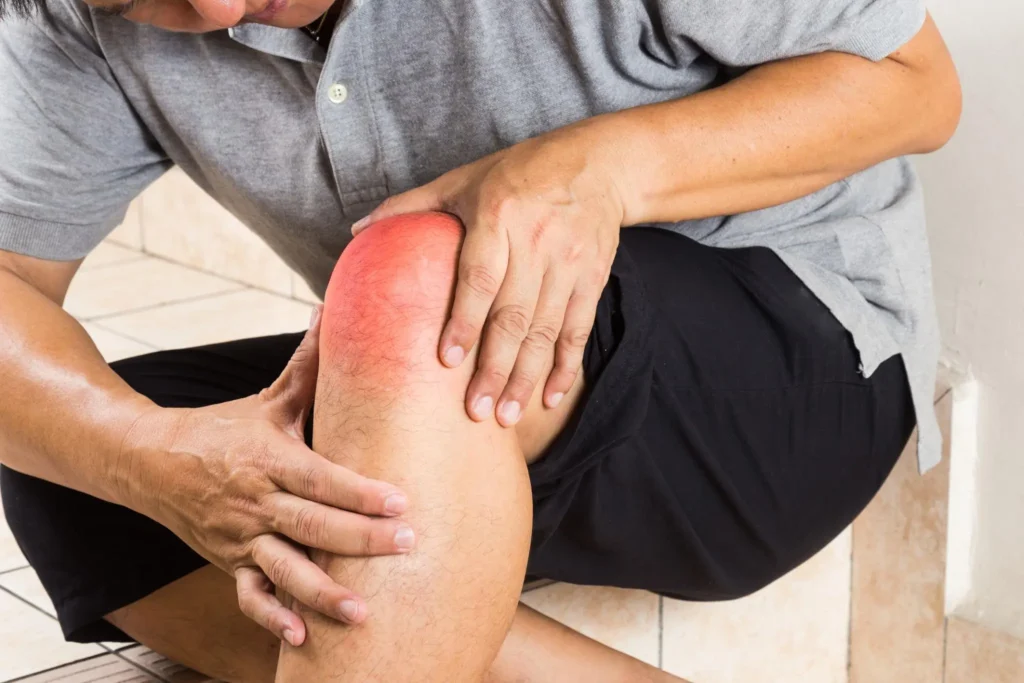
What Does It Actually Feel Like?
Depends entirely on the person, honestly. Some of the more common things we hear:
- Pain going up or down stairs, or just walking generally
- Stiffness after sitting for a while
- Swelling around the joint
- Pain when bending or squatting
- A sense that the knee feels weak or wobbly
- Soreness after a run or workout
- Difficulty getting the leg fully straight or fully bent
- The occasional click, or the odd feeling of something catching
Some people get hit with something sharp enough to stop them mid-step. Others get the slower version – a dull, background nuisance that quietly starts trimming away at what they’re willing to do. Fewer stairs taken at a time. Shorter walks. Sitting out a match they used to happily play.
It’s usually the second kind, oddly enough, that finally pushes people to book in and get it looked at.
Does Physiotherapy Genuinely Help?
For many people, yes – though knee pain physiotherapy was never supposed to be a single generic treatment handed out to whoever walks through the door with a sore knee.
Working out what’s actually happening comes first.
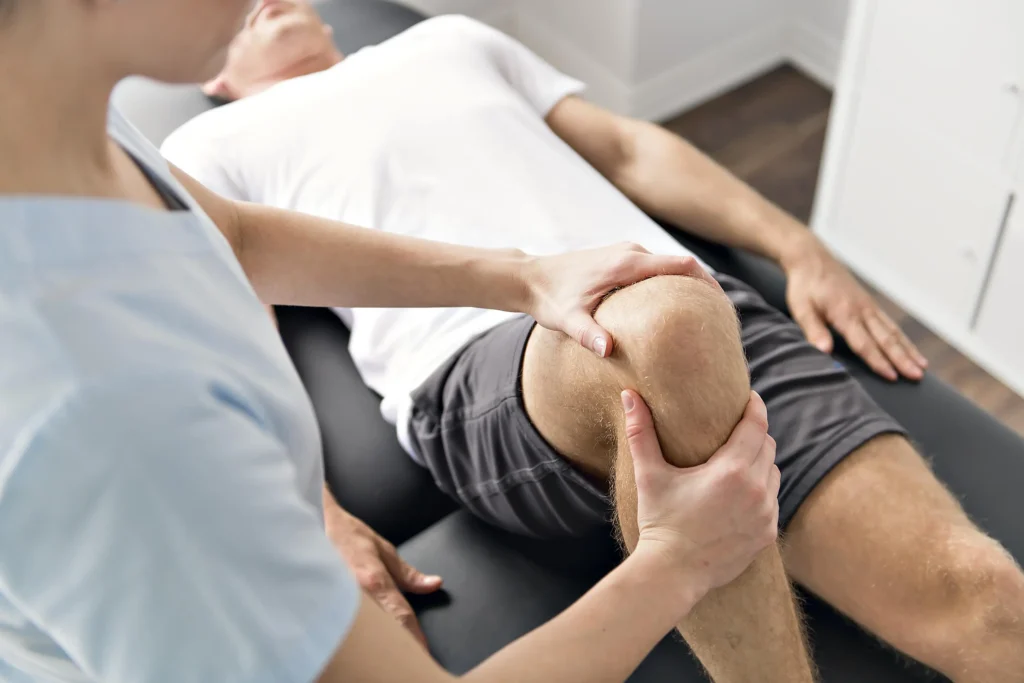
That usually means a physiotherapist looking at how the knee moves, checking strength, flexibility and balance, watching how you walk and finding out which activities bring on your symptoms. That gives us a much clearer picture of what needs attention.
From there, treatment might involve therapeutic exercise, strengthening, mobility work, guidance on which movements to modify and manual therapy where there’s a real reason for it. Physiotherapy can combine exercise and hands-on techniques to improve movement, strength and function.
At Fit O Fine, we shape the plan around the person rather than simply treating the sore spot. Your condition, your goals and the way you’re responding to treatment all influence what happens next.
The point isn’t just getting you through today comfortably. It’s helping you feel confident using the knee again in the things that matter to you.
What Exercises Genuinely Help?
Probably the question we field most and the honest answer isn’t the one people want: there’s no single magic exercise.
What helps depends on why your knee’s sore, how irritated it currently is and what it can genuinely handle right now. For some people, the priority is building strength around the knee and hip. For others, improving mobility, balance or movement control may matter more.
Where arthritis is involved specifically, exercise really does matter – it’s associated with improvements in pain and physical function.
A mistake we see fairly often is assuming more exercise equals faster progress. It doesn’t work that way. If something is reliably causing significant pain or swelling every time you do it, that’s a signal to change the approach rather than grit your teeth and repeat it.
A well-planned programme should progress as the knee improves instead of staying stuck at the same level from the first session onwards.
When Knee Pain Follows an Injury
This is a case where getting the problem assessed can genuinely change what happens next.
A knee twisted awkwardly during a football match isn’t necessarily dealing with the same issue as a knee that’s become stiff gradually over a couple of years with no clear starting point.
Following an injury, warning signs such as significant swelling, a feeling that the knee is giving way, trouble straightening it fully, or being unable to put weight through the leg point toward needing medical assessment rather than simply resting at home and hoping it settles.
And with sports injuries specifically, sports injury rehabilitation isn’t just about waiting until the pain fades. Strength, movement and – arguably just as important – confidence all need rebuilding before returning to demanding activity. Ligament injuries, sprains, strains and runner’s knee all sit under our sports injury work at the clinic.
Knee Pain After a Knee Replacement
Physiotherapy after a knee replacement isn’t a nice-to-have. It’s an important part of the recovery process.
The operation addresses the damaged joint. What happens afterward still involves restoring movement, rebuilding strength and getting comfortable using the knee again. None of that happens automatically because the surgery went smoothly.
Total knee and hip replacement rehabilitation is one of our orthopedic services at Fit O Fine and the programme can look different from one patient to another. Exercises need to be paced according to your surgery, symptoms and stage of recovery – not copied from someone else’s plan simply because the operation sounded similar.
Looking for the Best Knee Pain Physiotherapy in Bardhaman?
If you’re searching for the best knee pain physiotherapy in Bardhaman, don’t choose a clinic simply because it has a wall full of machines or promises that you’ll recover quickly.
Look for proper clinical assessment and an approach that makes sense for your condition.
A good physiotherapy plan should recognise the difference between arthritis, a sports injury, a post-surgical knee and other causes of knee pain. Those problems don’t necessarily respond to the same treatment.
At Fit O Fine Physiotherapy Clinic in Bardhaman, knee conditions are a regular part of our orthopedic and sports physiotherapy work, including osteoarthritis, post-replacement rehabilitation and runner’s knee.
The clinic is led by Dr. Satyen Bhattacharyya, Founder & Chief Physiotherapist, bringing more than 18 years of clinical and academic experience to the practice.
When Is It Actually Time to See a Physiotherapist?
You don’t need to book an appointment over every twinge. But it’s worth getting assessed if the pain is:
- Interfering with how you walk or go about your day
- Making stairs or standing up from a chair a genuine struggle
- Something that keeps returning
- Cutting into your exercise or sport
- Sitting alongside ongoing stiffness or weakness that won’t settle
- Not improving despite sensible rest and self-care
Get urgent medical attention, though, if the knee is severely painful, visibly swollen or oddly shaped, if you can’t move it or put any weight on it, or if it’s locking up or repeatedly giving way. A hot, red knee combined with fever or generally feeling unwell also needs urgent attention – infection needs ruling out there.
Where That Leaves You
Knee pain doesn’t automatically mean the joint is falling apart.
The problem could be an injury, joint changes, muscle weakness, or simply the way the knee is handling everyday movement. And sometimes what’s actually happening simply isn’t obvious until someone properly examines the knee.
Which is really the argument against reaching straight for the strongest painkiller you own or the most-watched exercise video you can find.
Work out what’s actually happening first.
Once you have a clearer picture, building a sensible rehabilitation plan becomes considerably easier.
If knee pain is chipping away at your ability to walk comfortably, exercise, manage stairs or simply get through a normal day, having it properly assessed is usually the first genuinely useful step towards moving with confidence again.
If you’d like to have your knee assessed, you can book a physiotherapy consultation with Fit O Fine.
Frequently Asked Questions
Q1: Can physiotherapy help knee pain?
Answer: Yes, in many cases. Physiotherapy can address strength, movement, flexibility, balance and overall function, with the specific approach depending on what’s behind your knee pain.
Q2: What’s the best exercise for knee pain?
Answer: There genuinely isn’t one exercise that suits everyone. What helps depends on the cause of your pain, your current strength and mobility and how irritated the knee is at the time.
Q3: Is knee pain always caused by arthritis?
Answer: No. It can come from an injury, sprain, ligament or tendon problem, a sports-related condition, or another joint issue altogether.
Q4: Can physiotherapy help knee arthritis specifically?
Answer: Yes. Exercise and physiotherapy are important parts of managing osteoarthritis and can help improve pain and day-to-day physical function.
Q5: Do I actually need physiotherapy after a knee replacement?
Answer: Physiotherapy is a standard and important part of recovery after knee replacement. The programme should be based on your specific surgery, symptoms and stage of recovery rather than a one-size-fits-all routine.
Q6: When should knee pain actually get checked out?
Answer: Book an assessment if it’s affecting your normal activities, keeps returning or simply isn’t improving. Seek urgent care for severe pain, major swelling or an oddly shaped knee, inability to bear weight, a locked knee, or a hot, red knee accompanied by fever or feeling unwell.
Q7: Can I keep exercising if my knee is sore?
Answer: Sometimes, depending on the cause and severity. Exercise can be an important part of knee rehabilitation, but repeatedly pushing through an activity that makes the pain or swelling worse isn’t the right approach. A physiotherapist can help determine what is appropriate for your particular situation.