
 +91 6295115701
 fitofine.in@gmail.com
 27A, Town Hall Para, Bardhaman, West Bengal
Sciatica Pain: Causes, Symptoms, Treatment & How Physiotherapy Can Help
A patient came in last month describing it as “like someone plugged my leg into a socket.” Another one calls it a hot wire running from her hip to her ankle. Everyone finds their own words for it, but the pattern underneath is usually the same: pain that starts around the lower back or buttock and then travels down one leg, sometimes with tingling, sometimes with a foot that just feels a bit dead.
For a good number of people it shows up more quietly than that. Sitting through a meeting used to be nothing. Now twenty minutes in, they’re shifting in the chair and by minute thirty it’s genuinely painful.
That’s sciatica, more often than not and it’s one of the conditions we deal with most regularly at the clinic.
Most people who book in describe it as”back pain on the phone. Understandable – that’s usually where it seems to start. But once we get into the details of where the pain travels, whether there’s numbness or tingling anywhere and what specific movements set it off, it frequently turns out to be a different picture than a standard backache.
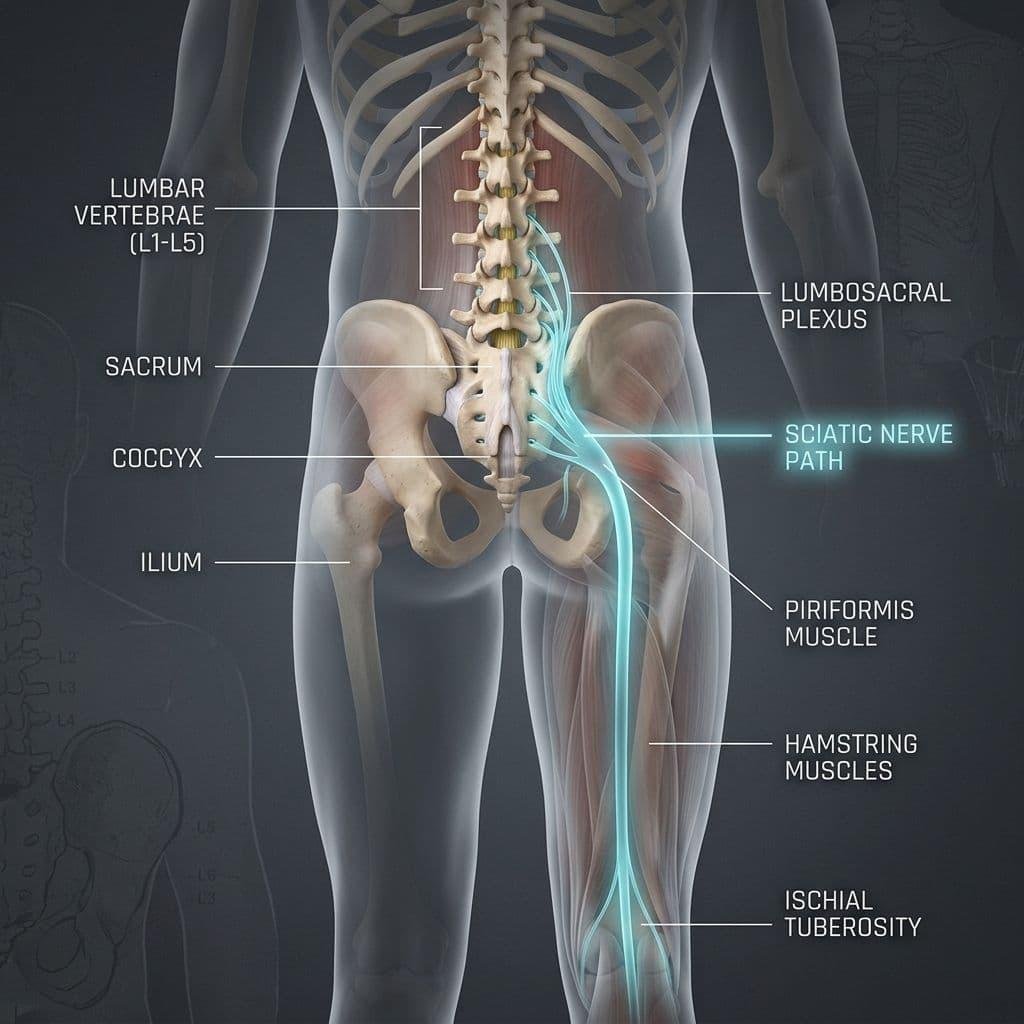
Sciatica and back pain get used interchangeably, but they’re not the same thing. Sciatica specifically means irritation or compression of the sciatic nerve, which runs from the lower back, through the buttock and down the length of the leg.
The reassuring part and it’s worth saying early: most cases do get better with the right approach and physiotherapy is usually a big piece of that.
What Is Sciatica, Really?
The sciatic nerve is the biggest nerve in the body. It begins in the lower spine, travels through the buttock and runs all the way down the leg.
When that nerve – or one of the smaller nerve roots that feed into it – gets squeezed or irritated somewhere along that route, the result is what gets called sciatica.
It’s almost always one-sided. Pain typically starts in the lower back or buttock and moves down the back of the thigh, sometimes stopping there, sometimes continuing into the calf or the foot. Alongside the pain, people often mention tingling, numbness, or a leg that feels weaker or heavier than usual.
One clarification worth making here: lower back pain on its own isn’t automatically sciatica. If it stays in the back and never reaches the leg, something else is more likely going on – which is really the argument for getting it checked instead of guessing based on a symptom you read about online.
What Actually Causes It
There’s rarely a single, clean answer.
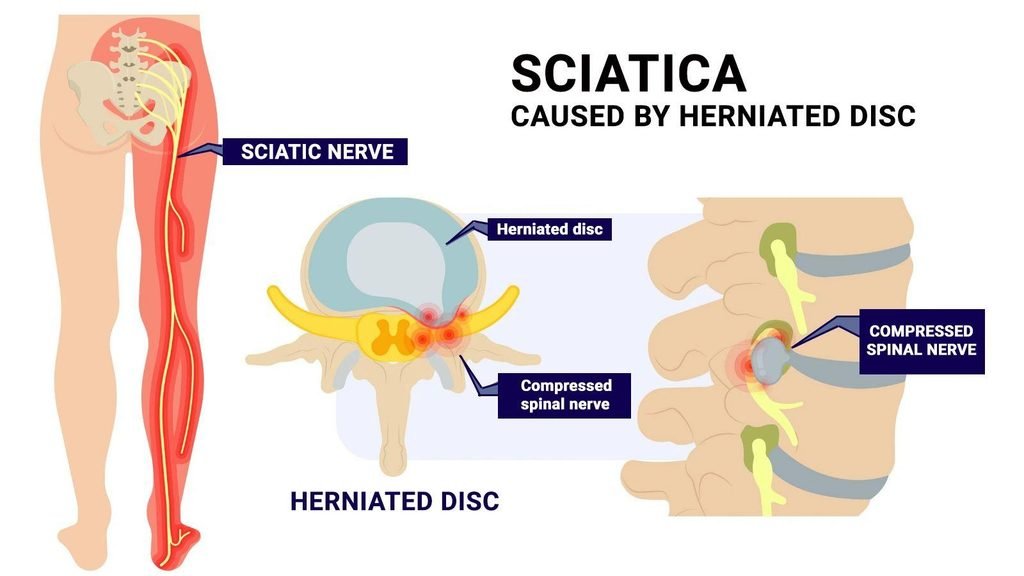
A slipped or herniated disc is the most frequent cause we come across. In simple terms, a disc bulges out of its normal position and presses against a nearby nerve root.
A few other things that commonly play a role:
- Spinal stenosis – the spaces around the spinal nerves narrow gradually over time
- Spondylolisthesis – one vertebra shifts slightly forward relative to the one beneath it
- Back injuries, whether from a specific incident or years of wear
- A range of other conditions that end up compressing or irritating the nerve
Sciatica sits within our orthopedic physiotherapy work at Fit O Fine, alongside disc bulges, lumbar spondylosis and spinal stenosis. It’s a fairly steady part of what we see week to week, not an unusual referral.
How Does It Actually Feel
Ask five patients and you’ll probably get five slightly different answers.
What tends to come up:
- Sharp or shooting pain down the leg
- A burning quality to it
- Pins and needles, or straightforward tingling
- Numb patches
- A leg or foot that feels noticeably weaker
- Pain that spikes with certain movements, or with a cough or a sneeze
A fair number of people are actually more troubled by the leg symptoms than by the back itself and they’re often surprised when that gets pointed out.
Which is really the reason it’s worth having it looked at rather than assuming it’s just another rough patch of back pain that’ll pass on its own.
Does Physiotherapy Actually Make a Difference?
It can, genuinely. But it was never about a laminated sheet of stretches handed to every patient regardless of what’s going on with them.
The starting point has to be actually understanding what’s happening.
At Fit O Fine, that means going through your symptoms, watching how you move, checking your strength and finding out which everyday things have become difficult. From that, we work out a plan around what’s actually driving your specific case rather than treating sciatica like it’s one condition with one universal fix.
Depending on what we find, treatment might involve targeted exercise, guidance on which movements to ease off for now, mobility work, strengthening and manual techniques where they’ll genuinely add something. Physiotherapy is generally recognised as one of the main ways sciatica gets managed, usually paired with exercise and other conservative, non-surgical approaches.
And to be clear about the aim here – it was never just about dulling the pain for an hour. It’s about you trusting your body enough to move normally again and getting back to whatever you actually need to do, whether that’s a full workday, your usual walk, or lifting your child without flinching first.
What About All the “Sciatica Exercise” Advice Online?
This is honestly where a lot of people end up going in circles.
Type “sciatica exercises” into a search bar and you’ll land on a dozen routines, each claiming to be the answer. The catch is that the same movement can genuinely help one person and aggravate another, because the underlying cause and what each person’s body can currently tolerate simply aren’t the same.
Some people respond well to gentle, early movement combined with specific strengthening. Others need their plan adjusted because a handful of movements are clearly making things worse and pushing through them doesn’t help – it sets them back.
NHS guidance broadly encourages staying as active as reasonably possible with appropriate exercise, rather than defaulting to long periods of sitting or lying down and waiting it out.
So exercise here isn’t a punishment and it isn’t a cure-all either. It’s one piece of a plan that should be built around your particular presentation, not copied from someone else’s.
Is Surgery Inevitable With Sciatica?
No – and for most people, it’s not even close to the likely outcome.
The majority of sciatica cases improve without any operation involved. Symptoms often settle over a few weeks to a few months, though some take longer and it’s not unusual for it to resurface at some point later.
Conservative care – staying active, the right exercise, physiotherapy, sensible pain management – is typically the first approach and it’s often the only one that’s ever needed.
That said, symptoms that are severe or simply refuse to ease sometimes call for a further medical opinion and surgery does come into the picture for a smaller subset of people, generally where other treatment hasn’t worked or where there’s meaningful nerve involvement that needs direct attention.
So being told you have sciatica isn’t the same as being told you’re headed for the operating table. For most people, that’s simply not where this goes.
When Is It Worth Seeing a Physiotherapist?
Worth booking an assessment if leg pain is interfering with walking, sitting, sleeping, work, or ordinary daily activities – or if this is a recurring thing that keeps showing up every few months regardless of what you try.
An assessment also helps rule in or rule out whether it’s genuinely sciatica, since a few other conditions can mimic it on the surface.
And this part matters: don’t dismiss the more serious warning signs. Get urgent medical care if you notice:
- Numbness around the genitals or anus
- New difficulty controlling your bladder or bowel
- Severe or rapidly worsening weakness or numbness in both legs
None of those are “wait for next week’s appointment” symptoms. They need attention right away.
Where This Leaves You
Sciatica can be a genuinely frustrating thing to live with. You’re walking around fine one day and the next, sitting down for dinner or bending to tie your shoes turns into something that takes real effort.
But pain running down your leg isn’t a life sentence.
The right way forward starts with actually understanding why the nerve is being irritated, working out what movements your body can currently manage and figuring out what needs to shift from there.
At Fit O Fine Physiotherapy Clinic in Bardhaman, sciatica is a condition we treat regularly, not something that catches us off guard. Our approach centres on the person in front of us, not on treating a painful spot in isolation and hoping it calms down on its own.
If pain from your back is reaching down into your leg, it’s worth getting it properly assessed rather than guessing. Understand what’s actually happening and take a real step toward moving the way you used to.
Frequently Asked Questions
Q1: What does sciatica pain actually feel like?
Answer: Typically sharp, shooting, or burning pain running from the lower back or buttock down one leg, sometimes reaching the calf or foot. Tingling, numbness and leg weakness are common as well and many people find the leg symptoms more bothersome than the back pain itself.
Q2: What’s the main cause of sciatica?
Answer: A slipped or herniated disc is the most common cause, where a bulging disc presses on a nearby nerve root. Spinal stenosis, spondylolisthesis and various back injuries or conditions that irritate the nerve can also be responsible.
Q3: Can physiotherapy actually help, or is it just exercises?
Answer: It can genuinely help and it involves far more than a generic set of exercises. Proper treatment starts with assessing your symptoms and movement, then building a plan around what’s actually behind your specific case – which can include targeted exercise, movement advice, mobility work and hands-on treatment where it’s appropriate.
Q4: How long does sciatica usually take to settle?
Answer: There’s no fixed timeline. Many people see their symptoms ease within a few weeks to a few months with appropriate conservative treatment. Some cases take longer and flare-ups later on aren’t unusual, which is part of why identifying the underlying cause actually matters.
Q5: Do I need surgery if I’ve got sciatica?
Answer: Most people don’t. The large majority of sciatica cases improve with conservative treatment – staying active, physiotherapy and sensible pain management. Surgery is generally reserved for a smaller group of cases involving severe, persistent symptoms or significant nerve compression.
Q6: What exercises should I actually be doing?
Answer: There’s no single correct set of sciatica exercises that suits everyone. It comes down to what’s causing your symptoms and which movements are currently making things worse. That’s why a proper assessment beats following a generic routine found online.
Q7: When should I be worried that my sciatica is something serious?
Answer: Most cases aren’t emergencies, but seek urgent medical attention if you notice numbness around the genitals or anus, new difficulty controlling your bladder or bowel, or severe, worsening weakness or numbness affecting both legs. These particular symptoms can point to a serious spinal problem.